
Social Commerce Market Outlook
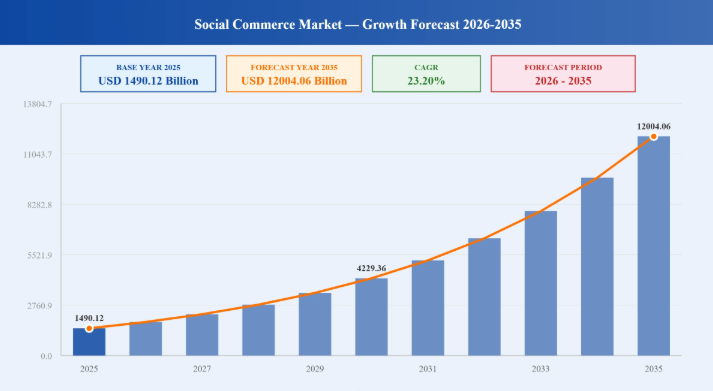
According to Expert Market Research (EMR), the global social commerce market was valued at USD 1490.12 billion in 2025. Aided by the growing popularity of social media platforms, increasing smartphone penetration, and the rising integration of shopping features into digital networks, the market is projected to grow at a compound annual growth rate (CAGR) of 23.20% between 2026 and 2035, reaching a value of USD 12004.06 billion by 2035.
Social commerce refers to the buying and selling of products and services directly through social media platforms and online communities. It combines social networking with e-commerce, enabling consumers to discover products, interact with brands, view recommendations, and complete purchases within an integrated digital environment. Features such as shoppable posts, livestream shopping, influencer recommendations, and in-app checkout are becoming important components of this retail model.
The increasing preference for convenient and interactive shopping experiences is driving the global social commerce market growth. Consumers are increasingly discovering products through short-form videos, creator content, and peer recommendations rather than relying exclusively on traditional online marketplaces. Additionally, businesses are using social platforms to engage customers, promote new products, and develop direct relationships with their target audiences, further supporting market expansion.
| Market indicator | Value |
|---|---|
| Market size in 2025 | USD 1,490.12 billion |
| Forecast market size by 2035 | USD 12,004.06 billion |
| CAGR (2026-2035) | 23.20% |
Social Commerce Industry Size and Share
The global social commerce market has experienced considerable expansion as businesses increasingly integrate social media marketing with online sales strategies. The growing availability of digital payment solutions, improved internet connectivity, and widespread adoption of mobile devices have made social shopping more accessible to consumers across different demographic groups.
In terms of market share, social networking platforms, video-sharing applications, and messaging-based commerce channels represent important distribution environments. Fashion, beauty, personal care, consumer electronics, and home products are among the categories well suited to social commerce because visual content and customer recommendations can influence purchasing decisions. The contribution of individual product categories and platforms varies according to consumer preferences, regional adoption, and platform capabilities.
Emerging economies offer considerable growth opportunities due to expanding internet access, increasing digital literacy, and the growing popularity of mobile-first shopping. Meanwhile, established markets benefit from advanced digital payment infrastructure, mature e-commerce ecosystems, and the presence of influential content creators. These developments are encouraging businesses of different sizes to adopt social commerce as part of their broader retail strategies.
Market Trends in the Social Commerce
The global social commerce market is witnessing several important trends, including livestream shopping, influencer-led product discovery, short-form video commerce, and personalised shopping recommendations. Livestream shopping enables sellers and creators to demonstrate products, answer questions, and interact with audiences in real time, creating a more engaging purchasing experience.
Influencer marketing is also playing a significant role in shaping consumer behaviour. Brands increasingly collaborate with content creators to showcase products through demonstrations, tutorials, reviews, and sponsored content. At the same time, user-generated content and customer feedback help potential buyers evaluate products before making purchasing decisions.
Another notable trend is the integration of shopping features directly into social media applications. Shoppable videos, product tags, and in-app purchasing options reduce the steps required to complete a transaction. This integration can simplify the customer journey and help businesses convert product discovery into sales more efficiently.
Drivers of Market Growth
The growth of the global social commerce market is primarily driven by increasing social media usage and changing consumer purchasing habits. Social platforms provide businesses with opportunities to reach targeted audiences through content, advertisements, and community engagement. Their interactive nature allows brands to communicate directly with customers and respond to changing preferences.
The expansion of influencer marketing and creator-led businesses is another major growth driver. Consumers often rely on demonstrations, reviews, and recommendations when evaluating unfamiliar products. Collaborations with relevant creators can help brands improve visibility and reach niche audiences without relying entirely on conventional advertising channels.
Furthermore, improvements in mobile payments, digital wallets, and online transaction security are supporting market development. These technologies make it easier for consumers to purchase products through digital platforms. Small businesses and independent sellers also benefit from social commerce because it can provide access to potential customers without requiring extensive investment in standalone e-commerce infrastructure.
Social Commerce Market Segmentation
The market based on the following segments:
Market Breakup by Business Model
- Business To Consumer (B2C)
- Business To Business (B2B)
- Consumer To Consumer (C2C)
Market Breakup by Product Type
- Apparel
- Home Products
- Food and Beverages
- Personal and Beauty Care
- Health Supplements
- Accessories
- Others
Market Breakup by Platform
- Social Network-Led Commerce
- Social Reselling
- Video Commerce
- Breakup by Type
- Live Stream
- Prerecorded
- Breakup by Type
- Product Review Platforms
- Group Buying
Market Breakup by Region
- North America
- Europe
- Asia Pacific
- ASEAN
- Latin America
- Middle East and Africa
Competitive Landscape
- Etsy Inc.
- Fashnear Technologies Private Limited (Meesho)
- Pinterest, Inc.
- Meta Platforms, Inc.
- Poshmark
- Pinduoduo Inc.
- Roposo
- Tiktok (Douyin)
- Twitter, Inc.
- Snap, Inc.
- Others
Technology and Advancements
Technological advancements are transforming social commerce through artificial intelligence (AI), machine learning, augmented reality (AR), and data analytics. AI-powered recommendation systems analyse browsing behaviour, engagement patterns, and purchasing preferences to present relevant products to users. These capabilities can improve product discovery and support personalised shopping experiences.
Augmented reality tools enable consumers to visualise selected products before purchasing them. For example, shoppers may use virtual try-on features for cosmetics and accessories or preview furniture within their homes. Such applications can improve product evaluation and help customers make more informed decisions.
Additionally, automated customer service tools and chatbots are helping businesses respond to enquiries, provide product information, and guide shoppers through purchasing processes. Improvements in payment integration and fraud detection are also strengthening the functionality and security of social commerce platforms.
Social Commerce Industry Analysis
The social commerce industry includes social media companies, online retailers, brands, influencers, payment service providers, and technology developers. Competition is influenced by platform engagement, content quality, product discovery capabilities, transaction convenience, and customer trust.
Large brands use social commerce to strengthen their digital presence, while small and medium-sized enterprises rely on these platforms to reach new customers and build communities around their products. Partnerships between brands and creators are becoming increasingly important for developing authentic promotional campaigns and increasing audience engagement.
Challenges and Opportunities
Despite its strong growth potential, the global social commerce market faces challenges related to data privacy, counterfeit products, misleading promotions, and inconsistent product quality. Consumer trust can be affected by fake reviews, undisclosed influencer partnerships, and difficulties resolving complaints or obtaining refunds.
Platform dependency also presents a concern for businesses, as changes in algorithms, advertising policies, and transaction fees can affect visibility and profitability. However, these challenges create opportunities for companies that prioritise transparent product information, secure payments, reliable fulfilment, and responsive customer service.
Further opportunities exist in emerging markets, personalised shopping, interactive product demonstrations, and improved integration between social platforms and inventory management systems. Businesses that combine engaging content with dependable purchasing experiences can strengthen customer relationships and encourage repeat sales.
Social Commerce Market Forecast
The global social commerce market is expected to maintain strong growth between 2026 and 2035, supported by digital transformation, expanding social media engagement, and the increasing convergence of content and online retail.
As businesses continue to adopt AI-driven recommendations, influencer marketing, livestream shopping, and integrated payment solutions, social commerce is expected to become an increasingly important sales channel. Companies that prioritise customer trust, personalisation, and convenient transactions are likely to be better positioned to capture emerging opportunities and support the long-term expansion of the global social commerce market.
Media Contact:
Company Name: Claight Corporation
Contact Person: George buttler, Corporate Sales Specialist – U.S.A.
Email: sales@expertmarketresearch.com
Toll Free Number: +1-415-325-5166 | +44-702-402-5790
Address: 30 North Gould Street, Sheridan, WY 82801, USA
Website: https://www.expertmarketresearch.com
Frequently Asked Questions (FAQs)
1. What is the global social commerce market?
The global social commerce market refers to the buying and selling of products and services directly through social media platforms, including shopping through shoppable posts, livestreams, influencer content, and integrated checkout features.
2. What was the global social commerce market size in 2025?
According to Expert Market Research, the global social commerce market was valued at USD 1,490.12 billion in 2025, supported by increasing social media usage and the growing adoption of digital shopping platforms.
3. What is the projected growth rate of the global social commerce market?
The global social commerce market is projected to grow at a compound annual growth rate (CAGR) of 23.20% between 2026 and 2035.
4. What is the expected value of the global social commerce market by 2035?
The global social commerce market is expected to reach approximately USD 12,004.06 billion by 2035, driven by influencer marketing, personalised recommendations, and integrated shopping experiences.
5. What are the key factors driving the global social commerce market?
The key growth drivers include increasing social media adoption, rising smartphone penetration, influencer-led product discovery, livestream shopping, AI-powered recommendations, and the growing availability of secure digital payment solutions.
