
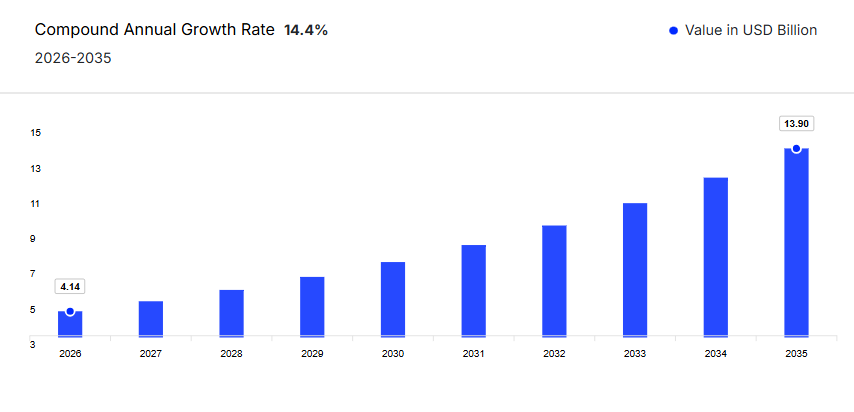
The global account reconciliation software market attained a value of USD 3.62 billion in 2025 and is projected to expand at a CAGR of 14.40% through 2035, reaching USD 13.90 billion by 2035. This growth reflects a clear shift in finance operations. Companies are replacing spreadsheets and manual matching with automated platforms that shorten the financial close, reduce errors and give auditors a clean record of every adjustment.
Account Reconciliation Software Market Overview
Account reconciliation software compares internal ledger records with external sources such as bank statements, customer payments, payment gateway settlements and inter-company balances. It flags mismatches, routes exceptions to the right owners and documents approvals so that balances can be certified with confidence.
The reconciliation software market is expanding because finance teams face more data than ever before. Digital payments, multi-currency operations, multiple banking relationships and complex group structures all increase the number of records that need to be matched every period. Manual reconciliation cannot keep pace with this volume, and it exposes organisations to delays, misstatements and compliance risk. As a result, reconciliation automation has moved from a back-office convenience to a core finance control.
| Attribute | Details |
|---|---|
| Market Value (2025) | USD 3.62 Billion |
| Forecast Value (2035) | USD 13.90 Billion |
| CAGR (2026-2035) | 14.40% |
| Key Segments | Component, Deployment Mode, Enterprise Size, Reconciliation Type, Industry Vertical, Region |
| Key Players | Broadridge Financial Solutions, Inc., BlackLine Inc., Oracle Corporation, ReconArt, Inc., Fiserv, Inc. |
Key Market Drivers
Rising transaction volumes. The growth of e-commerce, real-time payments and digital banking has multiplied the number of transactions that must be verified. Software can match very large volumes quickly using rules and algorithms, which is not practical for manual teams.
Pressure for a faster financial close. Finance leaders want shorter close cycles and near real-time visibility into cash positions and balance sheet accounts. Automated reconciliation removes bottlenecks at period end and supports the move towards continuous accounting.
Compliance and audit readiness. Stricter financial reporting standards and internal control requirements push organisations to maintain complete documentation. Reconciliation platforms provide approval workflows, version history and audit trails that reduce the effort of audits and regulatory reviews.
AI and machine learning adoption. Intelligent matching reduces the number of exceptions that need human review and learns from past resolutions. Vendors are investing in these capabilities, and they are increasingly a deciding factor in purchase decisions.
Cost and productivity gains. By cutting time spent on repetitive matching, organisations free skilled accountants to focus on analysis, forecasting and risk management.
Account Reconciliation Software Industry Constraints
Despite strong demand, several factors can slow adoption. Integration with legacy ERP systems and bank feeds can be complex and expensive. Poor data quality across source systems makes matching rules harder to configure. Some organisations are cautious about moving sensitive financial data to the cloud, and change management within finance teams can delay rollouts. Vendors are responding with pre-built connectors, phased implementation plans, strong security certifications and managed services that reduce the burden on internal teams.
Account Reconciliation Software Market Segmentation
| Segment | Sub-Segments |
|---|---|
| By Component | Software, Service |
| By Deployment Mode | On-Premise, Cloud |
| By Enterprise Size | Large Enterprises, Small and Medium Enterprises (SMEs) |
| By Reconciliation Type | Bank Reconciliation, Customer Reconciliation, Inter-Company Reconciliation, Others |
| By Industry Vertical | BFSI, Manufacturing, Retail and E-Commerce, Healthcare, IT and Telecom, Energy and Utilities, Government and Public Sector, Others |
| By Region | North America, Europe, Asia Pacific, Latin America, Middle East and Africa |
By Component
The market is segmented into software and service. The software segment includes matching engines, workflow management, exception handling, reporting and analytics modules. The service segment covers implementation, integration, training, consulting and ongoing support. As deployments grow more complex and span multiple systems and entities, demand for services rises alongside software licences and subscriptions.
By Deployment Mode
By deployment, the market is divided into on-premise and cloud. Cloud deployment is gaining preference because of lower upfront investment, scalability, faster updates and easier integration with cloud ERP and banking platforms. On-premise solutions remain relevant for organisations with strict data residency, security or customisation requirements, particularly in heavily regulated sectors.
By Enterprise Size
Large enterprises account for the leading share of adoption, driven by multi-entity structures, high transaction volumes and demanding compliance needs. Small and medium enterprises (SMEs) represent a fast-growing segment, supported by subscription pricing, simpler cloud tools and rising awareness of the cost of manual processes.
By Reconciliation Type
- Bank reconciliation: Matches ledger entries with bank statements and is the most widely used application. Demand for bank reconciliation system software is strong across every industry because every business holds bank accounts.
- Customer reconciliation: Aligns receivables with customer payments and supports faster cash application and dispute resolution.
- Inter-company reconciliation: Identifies and eliminates balances between related entities, which is essential for accurate consolidation in multinational groups.
- Others: Includes general ledger, portfolio and other specialised reconciliations.
By Industry Vertical
BFSI is a major user because of high transaction volumes, strict regulation and post-trade processing requirements. Retail and e-commerce is another important vertical, where retail recon software and e-commerce account reconciliation software handle payment gateway settlements, refunds, chargebacks and marketplace payouts. Manufacturing companies use reconciliation to manage supplier and inter-company balances. Healthcare organisations apply it to claims and payments. IT and telecom firms use it to manage billing at scale. Energy and utilities companies rely on it for areas such as energy spend reconciliation, while the government and public sector adopts it to improve transparency and control. Other industries are also adopting the technology gradually.
Regional Analysis
North America, including the United States and Canada, is a leading region. It benefits from a large base of enterprises, early cloud adoption and the presence of established software vendors.
Europe, covering the United Kingdom, Germany, France, Italy and other countries, is shaped by regulatory reporting requirements and the ongoing digitisation of finance functions.
Asia Pacific is expected to be among the fastest-growing regions. The India account reconciliation software market is supported by rapid growth in digital payments, an expanding e-commerce sector and rising demand for bank reconciliation software India based businesses can scale as they grow.
China and Japan are modernising finance operations at scale, while ASEAN economies, including the Vietnam account reconciliation software market, are adopting automation as digital commerce expands. The Australia account reconciliation software market reflects mature demand for cloud finance tools and strong compliance standards.
Latin America, including Brazil, Argentina and Mexico, is seeing growing interest as digital payments and financial regulation mature. In the Middle East and Africa, markets such as Saudi Arabia, the United Arab Emirates, Nigeria and South Africa are investing in digital finance infrastructure, which creates new opportunities for reconciliation providers.
Competitive Landscape
The market includes global finance technology companies and specialised reconciliation providers. Key players include:
- Broadridge Financial Solutions, Inc.
- BlackLine Inc.
- Oracle Corporation
- ReconArt, Inc.
- Fiserv, Inc.
Other vendors also compete, with many focusing on niche use cases or specific industries. Competition centres on matching accuracy, ease of integration, scalability, security and the strength of AI capabilities. Buyers who compare options, for example when looking for alternatives to Broadridge for reconciliation and financial data management, typically assess post-trade capability, deployment flexibility, implementation effort and total cost of ownership.
A notable trend is the choice between modular reconciliation components and packaged reconciliation applications. Modular tools offer flexibility and faster integration into existing systems, while packaged applications provide end-to-end workflows with less configuration. Vendors increasingly offer a mix of both to suit different customer needs.
Account Reconciliation Software Market Outlook
With a 14.40% CAGR through 2035, the market is expected to grow nearly fourfold from its 2025 base. Continued adoption of cloud platforms, AI-assisted matching and continuous accounting will shape demand. SMEs and emerging markets are likely to provide additional momentum as solutions become more accessible. Providers that combine strong integration, robust security and intelligent automation are well placed to capture this growth.
Conclusion
The account reconciliation software market is set to grow from USD 3.62 billion in 2025 to USD 13.90 billion by 2035, supported by higher transaction volumes, compliance needs and the push for faster, more accurate financial closes. For detailed segment-wise and country-level forecasts, refer to the full Account Reconciliation Software Market report by Expert Market Research.
FAQs
Q1. What is the size of the global account reconciliation software market?
The global account reconciliation software market attained a value of USD 3.62 Billion in 2025.
Q2. What is the expected growth rate of the account reconciliation software market?
The market is projected to grow at a CAGR of 14.40% through 2035.
Q3. What will the account reconciliation software market be worth by 2035?
The market is expected to reach USD 13.90 Billion by 2035, nearly four times its 2025 value.
Q4. What are the key segments of the account reconciliation software market
The market is segmented by component (software and service), deployment mode (on-premise and cloud), enterprise size (large enterprises and SMEs), reconciliation type (bank, customer, inter-company and others), industry vertical and region.
Q5. Who are the key players in the account reconciliation software market
Key players include Broadridge Financial Solutions, Inc., BlackLine Inc., Oracle Corporation, ReconArt, Inc., Fiserv, Inc., and others.
Q6. What is driving demand for account reconciliation software
Rising transaction volumes, the need for a faster financial close, compliance and audit requirements, and the adoption of AI-led matching are the main drivers.
Q7. Which regions are covered in the account reconciliation software market report?
The report covers North America, Europe, Asia Pacific, Latin America, and the Middle East and Africa, including countries such as the United States, India, China, Japan, Australia, the United Kingdom, Germany and Brazil.