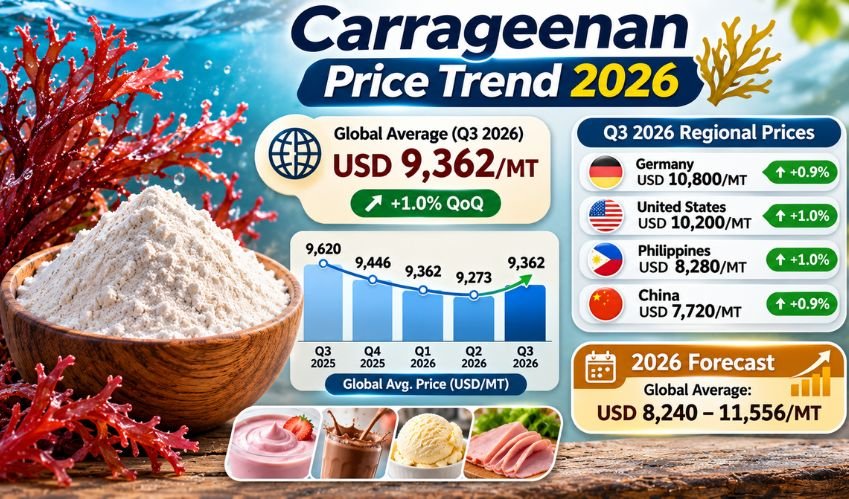
The carrageenan price trend in 2026 shows a market that has stopped falling and is beginning to firm. According to Expert Market Research, the global average rose 1.0% to USD 9,362/MT in Q3 2026, after easing in Q2. Firmer seaweed farm-gate prices and elevated processing energy costs lifted offers slightly, while steady demand from food makers kept buyers active. This article explains what moved prices, how each region performed, how the market got here and what to expect for the rest of 2026.
What Is Carrageenan and Why Does Its Price Move?
Carrageenan is a sulfated polysaccharide extracted from red seaweeds, mainly Kappaphycus and Eucheuma. It is sold in refined and semi-refined grades and in kappa, iota and lambda forms. Food and consumer product makers use it as a gelling, thickening and stabilizing agent in:
- Dairy desserts, chocolate milk and ice cream
- Processed meats
- Plant-based milks and meats
- Pet food, toothpaste and air freshener gels
Because dried seaweed is the raw material, carrageenan supply depends on farm output in Indonesia and the Philippines. That makes the market sensitive to three things:
- Seaweed farm-gate prices and supply: weather and disease affect harvests, and the cost of dried seaweed flows straight into extraction costs
- Food industry demand: dairy, meat, plant-based and pet food users place steady, recurring orders
- Processing costs: energy and alcohol are both used in extraction, so higher costs raise offers
When seaweed costs and energy costs rise together, producers pass the increase on. When harvests are ample and costs ease, prices drift lower, which is what happened through 2025.
Carrageenan Prices in Q3 2026
| Region | Q2 2026 (USD/MT) | Q3 2026 (USD/MT) | QoQ Change |
|---|---|---|---|
| Germany | 10,700 | 10,800 | +0.9% |
| United States | 10,100 | 10,200 | +1.0% |
| Philippines | 8,200 | 8,280 | +1.0% |
| China | 7,650 | 7,720 | +0.9% |
| Global Average | 9,273 | 9,362 | +1.0% |
Every region moved up by roughly one percent. The gains are small, but their consistency matters, because they came after a long stretch of declines and show that the downward pressure has eased.
Regional Analysis
Germany: Highest Price, Steady Demand
Germany remained the highest-cost market at USD 10,800/MT, up from USD 10,700/MT in Q2. Dairy, processed meat and plant-based food makers kept ordering steadily, and firm energy and seaweed costs held offers up. Buyers absorbed the higher quotes, procurement activity stayed steady through September and inventories remained broadly balanced across the supply chain.
United States: Costly Imports Support Prices
US prices rose to USD 10,200/MT from USD 10,100/MT. Dairy, plant-based and pet food makers kept their order books active, and imports of refined carrageenan stayed costly. Converters and distributors accepted the firmer quotations rather than pushing purchases into the fourth quarter, which suggests buyers did not expect prices to fall soon.
Philippines: Seaweed Supply Sets the Benchmark
Philippine prices edged up to USD 8,280/MT from USD 8,200/MT as dried seaweed farm-gate prices firmed. As a source market close to the raw material, the Philippines reflects seaweed costs most directly. Suppliers held offers firm while spot availability stayed limited, which kept sentiment constructive heading into the final quarter.
China: The Most Affordable Market
China remained the lowest-priced market at USD 7,720/MT, up from USD 7,650/MT. Imported seaweed and energy costs firmed, but large-scale processing capacity limited the increase. Contract negotiations for the fourth quarter opened with sellers seeking further rises, a sign that producers are working with a tighter cost structure.
From Falling Prices to a Slight Recovery
Carrageenan prices eased through most of 2025 on ample seaweed supply and moderating costs. They held steady in Q1 2026, dipped slightly in Q2 and then firmed in Q3.
| Quarter | Global Average (USD/MT) | QoQ Change | Direction |
|---|---|---|---|
| Q3 2025 | 9,620 | -1.8% | Falling |
| Q4 2025 | 9,446 | -1.8% | Falling |
| Q1 2026 | 9,362 | -0.9% | Falling |
| Q2 2026 | 9,273 | -0.9% | Falling |
| Q3 2026 | 9,362 | +1.0% | Rising |
Q3 2026 is the first quarter in this window to show a gain. Even so, the global average is still below the USD 9,620/MT recorded in Q3 2025, so the recovery is modest rather than a sharp rebound.
How Each Region Moved in 2025
| Region | Q1 2025 (approx. USD/MT) | Q4 2025 (USD/MT) | Change |
|---|---|---|---|
| Germany | 11,500 | 10,900 | Down roughly 5.2% |
| United States | 10,900 | 10,300 | Down roughly 5.5% |
| Philippines | 8,800 | 8,350 | Down roughly 5.1% |
| China | 8,200 | 7,780 | Down roughly 5.1% |
All four markets fell by a similar five percent over the year. That points to a market-wide cause, ample seaweed supply and easing costs, rather than a problem in any single country.
Carrageenan Price Forecast for 2026
Expert Market Research expects the market to stay stable to slightly firm through the rest of 2026. Seaweed supply is ample and food industry demand is steady, but energy and alcohol costs remain elevated, so prices have support from below while ample supply limits how far they can rise.
| Region | 2026 Price Range (USD/MT) | Outlook |
|---|---|---|
| Global Average | 8,240 – 11,556 | Seaweed costs and steady food demand keep the market stable to slightly firm |
| Germany | 10,044 – 11,556 | Dairy and meat demand sustains the highest price |
| United States | 9,486 – 10,914 | Dairy and plant-based demand supports firmness |
| Philippines | 7,700 – 8,860 | Seaweed supply sets the benchmark |
| China | 7,180 – 8,260 | Large-scale processing capacity keeps it the most affordable market |
Risks to the Outlook
What could push prices higher?
- Weaker seaweed harvests
- Higher energy and alcohol costs
What could pull prices lower?
- Larger seaweed harvests
- Weaker food industry demand
What This Means for Buyers
Contract talks in the coming months are likely to hinge on how feedstock costs and demand evolve. Procurement teams can respond in a few practical ways:
- Keep purchasing plans flexible rather than locking in long commitments too early
- Track seaweed farm-gate prices and freight conditions closely through the fourth quarter
- Benchmark supplier quotes against regional price ranges to spot offers that sit too high
- Compare sourcing options across Germany, the US, the Philippines and China, since the price gap between markets is wide
Conclusion
Carrageenan prices have turned from a year of gradual decline into a slight recovery, with the global average at USD 9,362/MT in Q3 2026. Germany and the US remain the premium markets, the Philippines tracks seaweed supply and China stays the lowest-cost source. With the outlook stable to slightly firm, buyers who watch seaweed costs and food demand will be best placed to manage their input costs.
Frequently Asked Questions
1. What was the carrageenan price in Q3 2026?
The global average was USD 9,362/MT. Prices ranged from USD 7,720/MT in China to USD 10,800/MT in Germany, with the United States at USD 10,200/MT and the Philippines at USD 8,280/MT.
2. Why did carrageenan prices firm slightly in Q3 2026
Raw seaweed farm-gate prices and processing energy costs firmed, while steady demand from dairy, meat and plant-based food makers supported offers.
3. Which region has the highest carrageenan prices?
Germany, at USD 10,800/MT in Q3 2026. Dairy and meat demand sustains its position at the top of the range, while China is the most affordable market thanks to its large-scale processing capacity.
4. What is the carrageenan price forecast for 2026?
The outlook is stable to slightly firm, supported by steady food demand and seaweed costs, while ample supply limits further gains.
5. How can procurement teams manage carrageenan price risk?
Monitor seaweed farm-gate prices, track freight conditions and benchmark supplier quotes against regional price ranges.
Need deeper pricing intelligence? Get regional benchmarks, grade-wise pricing, historical trends and a 3-month forecast in the Carrageenan Price Trend and Forecast report by Expert Market Research. Get Free Price Sample