
Food Flavours Market Outlook
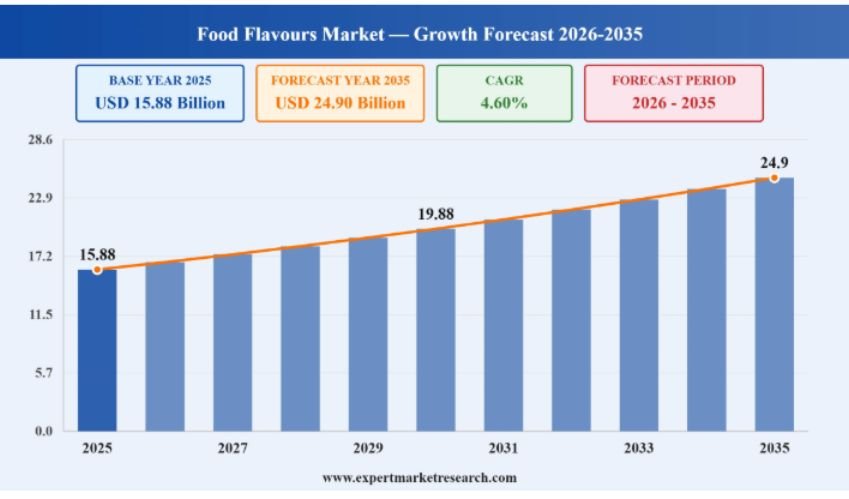
The global food flavours market reached a value of around USD 15.88 Billion in 2025. The market is projected to grow at a CAGR of 4.60% during the forecast period of 2026-2035, reaching a value of USD 24.90 Billion by 2035. Growth is supported by changing consumer preferences, increasing demand for convenient food products, and the expanding use of flavouring ingredients across beverages, dairy products, bakery items, confectionery, savoury snacks, and other food categories.
Food flavours play an important role in determining the taste, aroma, and overall sensory appeal of food and beverage products. Manufacturers use natural and artificial flavours to develop distinctive products, maintain consistency across production batches, and respond to evolving consumer preferences. As food companies continue to introduce new formulations and product varieties, flavour manufacturers are focusing on ingredient innovation, application-specific solutions, and improved formulation techniques.
The growing preference for products with recognisable ingredients is also influencing product development. Food manufacturers are exploring natural flavouring ingredients, fruit and botanical extracts, and other flavour solutions that support their product positioning. At the same time, artificial flavours continue to serve important applications where consistency, formulation flexibility, and cost considerations influence ingredient selection.
Global Food Flavours Market Size
The global food flavours market attained a value of around USD 15.88 Billion in 2025. Demand is supported by the widespread use of flavouring ingredients in packaged foods, ready-to-drink beverages, dairy products, confectionery, bakery products, and savoury snacks. Flavours help manufacturers differentiate their products in competitive markets while maintaining the taste profiles expected by consumers.
| Market Indicator | Details |
|---|---|
| Market size in 2025 | USD 15.88 Billion |
| Forecast period | 2026-2035 |
| CAGR during the forecast period | 4.60% |
| Projected market size by 2035 | USD 24.90 Billion |
The expansion of processed and packaged food consumption is an important factor supporting market development. Urban lifestyles, busy work schedules, and the availability of convenient food options have encouraged manufacturers to introduce products in different flavours and formats. Flavouring ingredients also help companies adapt established products to local preferences when entering new geographical markets.
The market is further influenced by the need for consistency in large-scale food production. Manufacturers must maintain a recognisable taste across different production batches, ingredient sources, and distribution markets. Flavour suppliers address these requirements by developing formulations suited to specific products, processing conditions, and storage requirements.
Food Flavours Market Share
The global food flavours market can be segmented by type into natural flavours and artificial flavours. Natural flavours are attracting growing attention owing to increasing consumer interest in recognisable ingredients and clean-label food products. These flavours are derived from natural sources such as fruits, vegetables, herbs, spices, and other botanical materials. Their application is expanding as manufacturers seek to develop products that align with changing preferences regarding ingredient transparency.
Artificial flavours continue to hold an important position in the industry due to their consistency, cost-effectiveness, and suitability for large-scale food production. They enable manufacturers to achieve specific taste profiles while maintaining uniformity across production batches. The choice between natural and artificial flavours depends on product requirements, regulatory considerations, manufacturing costs, and target consumer preferences.
By end user, the market includes beverages, dairy and frozen products, bakery and confectionery, savoury and snacks, and animal and pet food. Beverages represent an important application area because of the demand for flavoured water, soft drinks, juices, energy drinks, and other beverage categories. Dairy and frozen products use flavours to improve the taste of yoghurt, ice cream, desserts, and dairy-based beverages. Bakery and confectionery manufacturers incorporate flavouring ingredients into cakes, biscuits, chocolates, candies, and other sweet products.
Savoury foods and snacks require specialised flavour profiles to enhance products such as crisps, seasonings, sauces, instant meals, and ready-to-eat foods. The animal and pet food segment also creates opportunities for flavour manufacturers, as palatability is an important consideration in the development of pet food formulations.
Food Flavours Market Trends
The increasing preference for natural ingredients and clean-label products is one of the major trends shaping the food flavours market. Consumers are paying greater attention to ingredient lists and seeking products that align with their expectations regarding quality and transparency. In response, manufacturers are exploring natural extracts, botanical ingredients, and innovative flavour formulations.
Another significant trend is the growing interest in international cuisines and distinctive flavour combinations. Consumers are increasingly experimenting with regional spices, exotic fruits, smoky flavours, and sweet-and-savoury combinations. This trend is encouraging food manufacturers to diversify their product portfolios and introduce differentiated offerings across established and emerging categories.
The expansion of convenience food consumption is also supporting the use of flavouring ingredients. The growing fast food market is contributing to demand for consistent flavour profiles in sauces, seasonings, processed meat products, fried foods, and other prepared meals. Manufacturers are increasingly focusing on formulations that retain their sensory qualities during processing, transportation, and storage.
Drivers of Growth
The increasing consumption of processed and packaged foods is a key driver of the global food flavours market. Busy lifestyles, urbanisation, and changing eating habits have increased demand for convenient products that offer consistent taste and quality. Flavouring ingredients enable manufacturers to develop a wide variety of products while maintaining their desired sensory characteristics.
The growing beverage industry is another important contributor to market expansion. Demand for flavoured drinks, functional beverages, ready-to-drink products, and low-sugar alternatives is encouraging manufacturers to develop specialised flavour systems. These formulations help maintain taste appeal when sugar content is reduced or alternative ingredients are incorporated.
Furthermore, rising disposable incomes and evolving consumer expectations are supporting demand for premium food products. Manufacturers are using distinctive flavour combinations to differentiate their offerings, strengthen brand identity, and respond to regional preferences. The expanding application of flavouring ingredients in pet food is also creating additional growth opportunities.
Food Flavours Industry Segmentation
“Food Flavours Market Report and Forecast 2026-2035” offers a detailed analysis of the market based on the following segments:
Market Breakup by Type
- Natural Flavours
- Artificial Flavours
Market Breakup by End User
- Beverages
- Dairy and Frozen products
- Bakery and Confectionery
- Savoury and Snacks
- Animal and Pet Food
Market Breakup by Region
- North America
- Europe
- Asia Pacific
- Latin America
- Middle East and Africa
Technology and Advancement
Technological advancements are improving the development, extraction, and application of food flavours. Modern extraction techniques enable manufacturers to obtain flavour compounds from natural sources while improving process efficiency and product consistency. Encapsulation technologies are also being used to protect sensitive flavour compounds from heat, moisture, oxygen, and other environmental factors that can affect product quality.
Advances in analytical techniques and sensory evaluation are helping manufacturers understand flavour composition and improve formulation accuracy. Artificial intelligence and data analytics can support the identification of promising ingredient combinations by examining consumer preferences, product characteristics, and sensory information. These technologies can streamline product development and help manufacturers respond more quickly to changing market demand.
Fermentation and biotechnology are also creating opportunities for producing selected flavour compounds through alternative processes. Such advancements may support more consistent ingredient supply and provide additional options for manufacturers seeking specialised flavouring solutions.
Analysis Industry of Food Flavours Market
The global food flavours industry comprises established flavour houses, ingredient manufacturers, and specialised formulation providers. Competition is influenced by product quality, research and development capabilities, pricing, regulatory compliance, and the ability to supply customised solutions. Companies often collaborate with food and beverage manufacturers to develop flavour profiles suited to specific products and regional markets.
The industry also depends on reliable raw material sourcing and effective quality management. Natural flavour ingredients may be affected by seasonal availability, climatic conditions, and agricultural production fluctuations. Manufacturers must maintain consistency while meeting applicable food safety and flavour ingredient regulations across different markets. Investment in research, sustainable sourcing, and technical customer support remains important for maintaining competitiveness.
Regional Market Analysis
North America represents an important market for food flavours due to its established food processing industry, strong packaged food sector, and demand for innovative beverage and snack products. The United States and Canada provide opportunities for manufacturers developing natural flavours, premium formulations, and specialised ingredients for convenience foods.
Europe is supported by a mature food and beverage manufacturing base and increasing attention to ingredient transparency and product quality. The United Kingdom, Germany, France, and Italy represent important markets for flavouring applications across bakery products, dairy foods, beverages, and confectionery.
Asia Pacific offers growth opportunities owing to urbanisation, expanding food processing capacity, rising disposable incomes, and diverse regional food preferences. China, Japan, India, ASEAN countries, and Australia contribute to demand across multiple applications. Latin America, including Brazil, Argentina, and Mexico, is supported by the development of packaged food and beverage categories. Meanwhile, the Middle East and Africa present opportunities through expanding retail networks, foodservice activities, and demand for processed food products in countries such as Saudi Arabia, the United Arab Emirates, Nigeria, and South Africa.
Challenges and Opportunities
Fluctuating raw material prices and supply chain disruptions can create challenges for food flavour manufacturers. Natural ingredients may experience price volatility because of seasonal changes, crop availability, and weather conditions. Developing natural flavour formulations can also involve higher sourcing and processing costs, potentially affecting product pricing.
Regulatory requirements and changing consumer expectations create additional complexities. Manufacturers must ensure ingredient safety, appropriate labelling, and compliance with the regulations applicable to their target markets. At the same time, opportunities are emerging through clean-label products, plant-based foods, innovative beverages, pet food, and customised flavour solutions. Companies that invest in research, sustainable sourcing, and advanced processing technologies may strengthen their market position.
Competitive Landscape
The global food flavours market includes established ingredient suppliers that compete through product development, application expertise, customer relationships, and international distribution capabilities. Companies may differentiate their offerings through flavour portfolios, technical support, research capabilities, and their ability to respond to changing requirements across food and beverage applications.
Key companies operating in the market include:
- Firmenich SA
- Frutarom
- Givaudan Group
- Sensient Technologies Corporation
- Kerry Group, PLC.
- Robertet SA
- Others
Competition is influenced by the ability to develop flavour solutions suited to different products, maintain consistent quality, and meet customer specifications. Research and development, formulation support, sourcing strategies, and regulatory expertise can also contribute to competitive positioning. Companies that respond effectively to evolving consumer preferences and application requirements may be better placed to pursue new business opportunities.
Food Flavours Market Forecast
The global food flavours market is expected to maintain steady growth throughout the 2026-2035 forecast period, reaching USD 24.90 billion by 2035 from approximately USD 15.88 billion in 2025. The projected CAGR of 4.60% reflects continued demand for processed foods, innovative beverages, bakery products, confectionery, and specialised flavour formulations.
Growing interest in natural ingredients, advancements in flavour technologies, and the development of new food categories are expected to create further opportunities. As manufacturers continue to prioritise taste consistency, product differentiation, and evolving consumer preferences, food flavours are likely to remain an essential component of the global food and beverage industry.