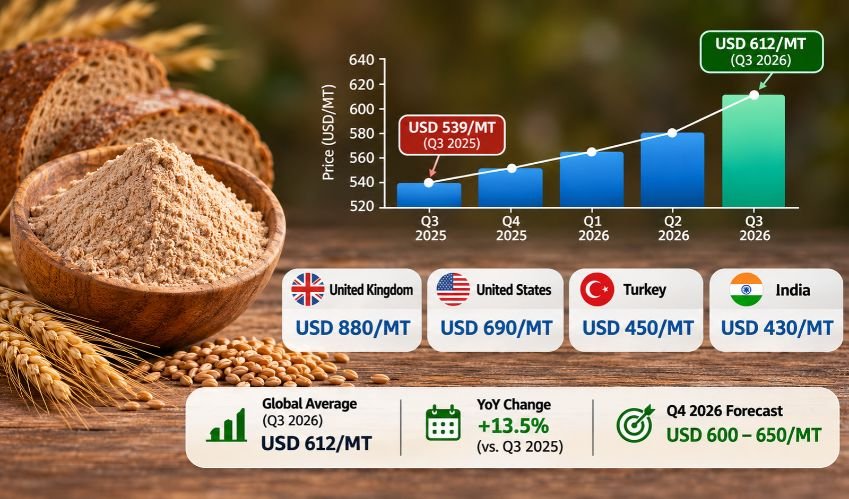
The brown flour price trend moved sharply higher in the third quarter of 2026. After a quiet 2025, prices rose in every major market we track, and the global average jumped 5.5% in a single quarter. For bakeries, atta mills, snack makers and procurement teams, the brown flour price trend is now a key number to watch because it feeds directly into the cost of bread, chapatis, biscuits and snacks. This article explains the latest brown flour price trend, what pushed prices up, how the United Kingdom, United States, Turkey and India compare, and what to expect in Q4 2026.
What Is Brown Flour and What Drives Its Price?
Brown flour is milled from wheat with part of the bran and germ left in. That gives it a darker colour, more fibre and a nuttier taste than white flour. It goes into brown and wholemeal bread, chapatis and atta, biscuits and snacks.
The brown flour price trend follows wheat first, and then a few other costs:
- Wheat prices: Wheat is the main raw material, so any move in wheat reaches flour with a short delay.
- Milling costs: Energy, labour and packaging affect the mill’s margin.
- Whole grain premium: Consumers often pay extra for wholemeal and brown products.
- Currency moves: A weaker currency makes imported wheat more expensive.
- Weather and shipping: Dry spells and shipping problems can lift wheat prices quickly.
One more point matters. Most flour is milled close to where it is eaten, so the brown flour price trend follows local wheat prices more than international trade flows. Turkey and India are big milling countries, while the United Kingdom and the United States mill both home-grown and imported wheat.
Brown Flour Price Trend in Q3 2026
The United Kingdom paid the most in Q3 2026, at USD 880/MT. The global average rose 5.5% to USD 612/MT from USD 580/MT in Q2. The main reasons were higher wheat prices, driven by Black Sea shipping problems and dry weather in North America. Millers passed the extra cost on to bakeries and retailers.
| Country | Q3 2026 (USD/MT) | Q2 2026 (USD/MT) | QoQ Change |
|---|---|---|---|
| United Kingdom | 880 | 835 | +5.4% |
| United States | 690 | 650 | +6.2% |
| Turkey | 450 | 420 | +7.1% |
| India | 430 | 415 | +3.6% |
| Global Average | 612 | 580 | +5.5% |
Turkey recorded the sharpest quarterly rise, while India saw the mildest. Even so, the order stayed the same: the UK was the most expensive market and India the cheapest.
Year-on-Year Brown Flour Price Trend
Comparing with the same quarter last year shows how big the move really is. Every market is well above its Q3 2025 level:
| Country | Q3 2026 (USD/MT) | Q3 2025 (USD/MT) | YoY Change |
|---|---|---|---|
| Turkey | 450 | 380 | +18.4% |
| United States | 690 | 600 | +15.0% |
| United Kingdom | 880 | 775 | +13.5% |
| India | 430 | 400 | +7.5% |
| Global Average | 612 | 539 | +13.5% |
So the brown flour price trend is not a short spike. Buyers are paying noticeably more than they did a year ago, and the increase is spread across all four markets.
Brown Flour Price Trend by Country
United Kingdom
The UK averaged USD 880/MT in Q3 2026, which is 43.8% above the four-market average. Millers paid more for wheat after the Black Sea shipping scare and passed the increase on, while bakeries kept buying wholemeal and brown loaves. High wheat import costs, mill margins and the premium for wholemeal flour keep British prices the highest. Compared with Q4 2025, the UK price is up 10.7%.
United States
US prices rose 6.2% to USD 690/MT. Dry weather in parts of North America ahead of sowing lifted wheat futures, and mills raised their whole wheat flour offers. Demand for whole grain bread and snacks stayed steady. The US sits 12.7% above the global average, and its price is 12.2% higher than at the end of 2025.
Turkey
Turkey climbed 7.1% to USD 450/MT. The state raised its purchase price for the new wheat crop by about 22%, and millers passed that cost on. Export enquiries also picked up. Turkey is 26.5% below the global average, but it has risen 14.8% since Q4 2025, the fastest of the four markets.
India
India rose 3.6% to USD 430/MT. Retailers stocked up ahead of the festival season, and mills passed higher wheat costs on to wholesalers. India is 29.7% below the global average, which makes it the cheapest origin, and it is up 6.2% since the end of 2025.
Quarterly Brown Flour Price Trend
The global average was flat through most of 2025, then rose steadily through 2026:
| Quarter | Global Price (USD/MT) | QoQ Change | Direction |
|---|---|---|---|
| Q3 2026 | 612 | +5.5% | ↑ Rising |
| Q2 2026 | 580 | +2.7% | ↑ Rising |
| Q1 2026 | 565 | +2.4% | ↑ Rising |
| Q4 2025 | 552 | +2.4% | ↑ Rising |
| Q3 2025 | 539 | -0.4% | → Stable |
The pattern is clear. Comfortable wheat supply kept prices down in the middle of 2025, and firmer wheat costs drove the increases in 2026. Across the whole window from Q1 2025 (USD 548/MT) to Q3 2026, the net gain is roughly 11.7%.
What Happened to Brown Flour Prices in 2025?
2025 was a quiet year. Prices slipped in the middle of the year because wheat was in ample supply, then recovered in Q4. The global average moved from about USD 548/MT to USD 552/MT, a gain of only 0.7%. The picture differed by country:
- United Kingdom: USD 790/MT to USD 795/MT (up roughly 0.6%)
- United States: USD 620/MT to USD 615/MT (down roughly 0.8%)
- Turkey: USD 395/MT to USD 392/MT (down roughly 0.8%)
- India: USD 385/MT to USD 405/MT (up roughly 5.2%)
India was the only market with a clear rise in 2025, as wheat procurement costs went up and atta demand stayed firm. The others were close to flat. That calm made the 2026 jump feel larger.
Brown Flour Price Forecast for Q4 2026
The brown flour price trend is expected to stay firm through the end of 2026. Wheat has risen, and millers are still passing the increase on with a lag. Bakery demand is steady, so buyers have little room to push back.
| Region | Expected Range (USD/MT) | Outlook |
|---|---|---|
| Global Average | 600 – 650 | Firm wheat costs and steady bakery demand |
| United Kingdom | 862 – 934 | Wheat costs and bakery demand keep prices highest |
| United States | 676 – 732 | Higher wheat futures support mill offers |
| Turkey | 445 – 483 | Higher state wheat price feeds through to flour |
| India | 419 – 453 | Festival demand and wheat costs lift atta |
The risks lean toward higher prices.
What could push prices higher:
- More Black Sea disruption
- Poor sowing conditions
- A weaker currency in importing countries
What could pull prices lower:
- A larger Southern Hemisphere wheat crop
- Easing freight costs
- Weaker demand for whole grain products
How Buyers Can Use the Brown Flour Price Trend
Price data is only useful when it changes a decision. A few practical steps follow from the numbers:
- Link contracts to wheat. Because flour follows wheat, tying flour prices to a wheat index keeps costs more predictable.
- Buy ahead of winter. Bakery demand is usually strong in the colder months, so buying early can protect margins.
- Qualify a second mill. Having a backup supplier reduces the risk if one mill raises prices or faces disruption.
- Watch currency and freight. In importing countries, a weaker currency or costly shipping can lift flour prices even when wheat is stable.
- Track the whole grain premium. The gap between white and brown flour tells you how much extra consumers are willing to pay.
Frequently Asked Questions
1. What is the current brown flour price trend?
The brown flour price trend is upward. In Q3 2026 the global average rose 5.5% to USD 612/MT. Prices were USD 880/MT in the United Kingdom, USD 690/MT in the United States, USD 450/MT in Turkey and USD 430/MT in India.
2. Why did brown flour prices rise in Q3 2026?
Wheat prices climbed because of Black Sea shipping problems and dry weather in North America. Millers then passed the higher cost on to bakeries and retailers.
3. What is the brown flour price forecast for Q4 2026?
The global average is expected to stay between USD 600 and 650/MT. Firm wheat costs and steady bakery demand point to a flat to slightly higher range.
4. Which country has the highest brown flour prices?
The United Kingdom has the highest prices because of wheat import costs, mill margins and the premium for wholemeal flour. India has the lowest prices because it relies on local wheat.
5. What factors influence the brown flour price trend?
Wheat prices are the biggest factor. Currency moves, energy costs, freight, weather and demand for whole grain products also shape the brown flour price trend.
Final Thoughts on the Brown Flour Price Trend
The brown flour price trend has moved from a calm 2025 to a clear upswing in 2026. Wheat costs are the main driver, and millers are still passing the increase on. For buyers, the next few months look firm rather than relaxed, so planning purchases early and keeping a second supplier ready are sensible steps. Keeping an eye on wheat, currency and freight will help you stay ahead of the next move in the brown flour price trend.
For a wider view of food ingredient costs, see the carrageenan price trend as well.