The brown eggs price trend over the past two years has been one of the most dramatic in the food commodity space. Prices in the United States collapsed from a record peak, German prices hit records and then eased, and Brazil and India moved on their own local rhythms. Whether you are a buyer, trader, bakery owner or analyst, you want three answers: what prices are today, why they moved, and where they are heading. This guide covers all three using the latest quarterly data.
What Are Brown Eggs and Why Do Their Prices Matter?
Brown eggs are shell eggs from hens that lay brown-shelled eggs. They are the main type in India, Brazil and much of Europe, and they make up more than half of the United States market. The shell colour comes from the breed of the hen and does not change the nutritional value. Prices are shaped by other factors, which this article explains below. China, India, the United States and Brazil are the biggest producers, and most eggs are eaten close to where they are produced.
Brown Eggs Price Trend at a Glance: Q3 2026
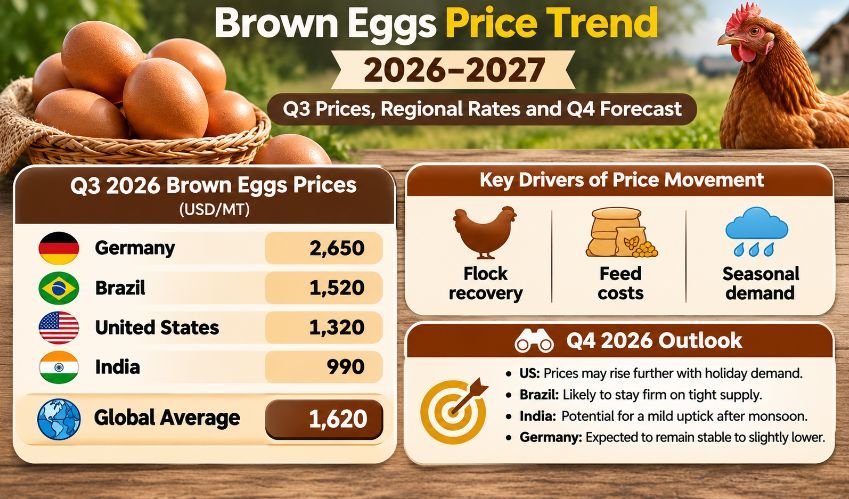
Germany paid the most for brown eggs in Q3 2026, while India paid the least. The global average fell 4.8% to USD 1,620/MT from USD 1,702/MT in Q2, because falls in Germany and India outweighed a rebound in the United States from a very low base.
Here is the brown eggs price trend in each market for Q3 2026:
| Market | Q3 2026 Price (USD/MT) | Change vs Q2 2026 | Change vs Q3 2025 | Position vs Global Average |
|---|---|---|---|---|
| Germany | 2,650 | -15.6% | -11.7% | 63.6% above |
| Brazil | 1,520 | +3.4% | +14.3% | 6.2% below |
| United States | 1,320 | +14.8% | -74.2% | 18.5% below |
| India | 990 | -5.7% | +5.3% | 38.9% below |
| Global Average | 1,620 | -4.8% | -37.6% | – |
How to read this: Germany is the most expensive market by a wide margin, trading 63.6% above the global average, because of high labour and housing costs for hens, strict welfare rules and a premium for eggs from barn and free-range systems. India sits at the bottom, 38.9% below the average.
Why the Brown Eggs Price Trend Differs by Country
United States: Rebound From a Very Low Base
- Price: USD 1,320/MT in Q3 2026, up 14.8% from USD 1,150/MT in Q2.
- Why it rose: Holiday buying began and large retailers rebuilt stocks. Flock numbers are back near normal and inventories stayed adequate, which limited the rebound.
Brazil: Tight Supply and Firm Retail Demand
- Price: USD 1,520/MT in Q3 2026, up 3.4% from USD 1,470/MT in Q2.
- Why it rose: Egg production for consumption stayed below last year, and retail demand for red eggs held firm, so wholesale buyers paid more.
India: Monsoon Dip
- Price: USD 990/MT in Q3 2026, down 5.7% from USD 1,050/MT in Q2.
- Why it fell: Religious fasting periods and heavy monsoon rain cut consumption, and farm prices softened as stocks built up.
Germany: Supply Growth and Record Imports
- Price: USD 2,650/MT in Q3 2026, down 15.6% from USD 3,140/MT in Q2.
- Why it fell: Supply grew, imports reached record levels and retailers cut the prices of eggs from barn and free-range systems, which pulled wholesale quotes down from the early-year peak.
Quarterly Brown Eggs Price Trend: Six Straight Declines
The global average fell every quarter after Q1 2025, from USD 3,532/MT to USD 1,620/MT in Q3 2026, a net decline of roughly 54.1%.
| Quarter | Global Average (USD/MT) | QoQ Change |
|---|---|---|
| Q1 2025 | 3,532 | – |
| Q2 2025 | 2,780 | – |
| Q3 2025 | 2,595 | -6.7% |
| Q4 2025 | 2,238 | -13.8% |
| Q1 2026 | 2,051 | -8.4% |
| Q2 2026 | 1,702 | -17.0% |
| Q3 2026 | 1,620 | -4.8% |
What this means: The slide was steepest in Q2 2026, when the average dropped 17.0%. Flock recovery in the United States and heavy supply in Europe drove the 2026 declines, while Brazil gained.
Brown Eggs Price Trend in 2025: What Happened?
2025 was a year of sharp divergence. US prices fell in every quarter after a record peak, while German prices rose in every quarter on tight supply. The global average ended the year at USD 2,238/MT, about 36.6% below its Q1 level. US prices peaked near USD 8 per dozen in early 2025, and by early 2026 they had fallen to about USD 1.
Here is how each market moved during 2025 (approximate values):
| Market | Q1 2025 (USD/MT) | Q4 2025 (USD/MT) | Change |
|---|---|---|---|
| Germany | 2,700 | 3,380 | +25.2% |
| Brazil | 1,380 | 1,260 | -8.7% |
| India | 1,070 | 1,100 | +2.8% |
| United States | 8,980 | 3,210 | -64.3% |
| Global Average | 3,532 | 2,238 | -36.6% |
Key takeaway: Germany’s rise and the US collapse pulled in opposite directions, which is why one global average hides very different local stories. Avian influenza losses and flock rebuilding, feed costs and seasonal demand shaped the year.
Brown Eggs Price Trend Forecast for Q4 2026
Prices are expected to move in different directions through the rest of 2026. Holiday baking demand usually lifts US prices from the very low base, and flock numbers are back near normal, which keeps the rise from running away. Germany is expected to ease further as supply grows, while India should recover as winter demand returns. The global average is expected between USD 1,546 and USD 1,849/MT.
| Market | Expected Q4 2026 Range (USD/MT) | Outlook |
|---|---|---|
| Global Average | 1,546 – 1,849 | Holiday demand lifts the US while Germany eases |
| United States | 1,371 – 1,745 | Holiday baking demand lifts prices from lows |
| Brazil | 1,441 – 1,691 | Lower output and rising feed costs hold prices |
| India | 983 – 1,155 | Winter demand lifts prices from the monsoon low |
| Germany | 2,389 – 2,805 | Strong supply and imports ease prices |
What Could Push Prices Higher?
- A new avian influenza outbreak
- Stronger holiday demand
- Higher feed costs
What Could Pull Prices Lower?
- Larger flocks
- Weaker consumer demand
- More imports into Europe
Risks are weighted toward higher prices in the United States and lower prices in Europe.
Key Drivers Behind the Brown Eggs Price Trend
- Avian influenza: The biggest risk to supply, as the United States showed with its swing from a record peak to very low prices.
- Feed costs: Corn and soybean meal make up the main feed expense, so higher grain prices raise egg prices.
- Housing, labour and welfare rules: Barn and free-range systems cost more to run, which is why German prices carry a premium.
- Flock size: Larger flocks mean more supply and lower prices, as seen in the US recovery.
- Seasonal demand: Easter and winter holidays lift demand, while fasting periods and monsoon rain in India reduce it.
- Imports: Trade is limited, but emergency and record imports can pull prices down, as in Germany.
What the Brown Eggs Price Trend Means for Buyers
- Fix prices before the winter holidays. Holiday baking demand usually lifts US prices from the low base.
- Watch outbreak news. A new avian influenza outbreak is the biggest risk to supply and can lift prices.
- Keep a second supplier in a neighbouring region. Trade is limited to neighbouring countries, so a nearby backup protects supply.
Conclusion
The brown eggs price trend over the last seven quarters is a story of a long decline from a record peak. The global average fell from USD 3,532/MT in Q1 2025 to USD 1,620/MT in Q3 2026, with the United States and Germany leading the drop and Brazil moving the other way. Germany remains the most expensive market at USD 2,650/MT and India the cheapest at USD 990/MT. For Q4 2026, expect a flat to slightly higher global range of USD 1,546-1,849/MT, with holiday demand lifting the US and Europe easing. Buyers who plan ahead for the holidays and watch avian influenza news will manage this brown eggs price trend best.
Frequently Asked Questions (FAQs)
1. What is the current brown eggs price trend?
In Q3 2026, brown eggs averaged USD 1,320/MT in the United States, USD 1,520/MT in Brazil, USD 990/MT in India and USD 2,650/MT in Germany. The global average was USD 1,620/MT, down 4.8% from Q2. Germany was the priciest market and India the cheapest.
2. Why did the brown eggs price trend turn lower in Q3 2026?
The global average fell because drops in Germany (-15.6%) and India (-5.7%) outweighed a rebound in the United States (+14.8%). German supply grew, imports reached record levels and retailers cut shelf prices, while Indian demand weakened during fasting periods and heavy monsoon rain.
3. What is the brown eggs price trend forecast for Q4 2026?
The global average is expected between USD 1,546 and USD 1,849/MT, a flat to slightly higher range. Holiday baking demand should lift US prices from a low base, while Germany is expected to ease as supply grows. India should recover on winter demand.
4. Which country has the highest brown eggs prices and why?
Germany, at USD 2,650/MT in Q3 2026, is 63.6% above the global average. High labour and housing costs for hens, strict welfare rules and a premium for barn and free-range eggs keep German prices above the United States, Brazil and India.
5. How can buyers manage brown eggs price volatility?
Fix prices before the winter holidays, follow avian influenza news and keep a second supplier in a neighbouring region. Because most eggs are consumed close to where they are produced, a nearby backup helps protect against local supply shocks.